



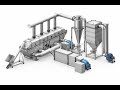

The Continuous Fluid Bed Dryer is designed for efficient and uniform drying of powders, granules, and crystals. In this system, hot air continuously passes through a perforated bed, fluidizing the material for consistent moisture removal. This continuous process ensures high drying efficiency, uniform product quality, and energy savings. Suitable for pharmaceutical, chemical, and food industries, it offers reliable performance for large-scale drying applications.
Working Principle
The Continuous Fluid Bed Dryer (CFBD) operates on the principle of fluidization, where hot air is passed through a perforated distributor plate to create a fluid-like motion of solid particles.
-
Feeding:
The wet material (powder, granules, or crystals) is continuously fed into the dryer through a controlled feeding system such as a screw feeder or rotary valve. -
Fluidization & Drying:
Pre-heated air enters from the bottom of the dryer and flows upward through the perforated bed. The air velocity is adjusted to suspend and fluidize the material, ensuring intense mixing and uniform heat transfer. Moisture is rapidly evaporated from the particles during this stage. -
Material Movement:
The fluidized material moves gradually from the feed end to the discharge end, allowing for continuous drying. The residence time can be controlled by adjusting feed rate and air velocity. -
Exhaust & Filtration:
The moist air carrying evaporated moisture passes through a dust collection or bag filter system before being discharged to the atmosphere or recirculated via a heat recovery system. -
Discharge:
The dried product is continuously discharged from the outlet and can be sent directly to the next process such as cooling, milling, or packaging.
Features
-
Continuous drying operation with uniform air distribution.
-
Available in SS304 / SS316 / SS316L construction.
-
Controlled inlet and outlet air temperature for precise drying.
-
Adjustable feed rate and residence time.
-
Compact design with easy access for cleaning and maintenance.
-
Energy-efficient air handling and heat recovery system.
-
Optional explosion-proof design for solvent-based materials.
-
PLC-based automation with touch-screen control (optional).
Advantages
-
High Efficiency: Continuous drying reduces process time and energy consumption.
-
Uniform Drying: Ensures consistent moisture content across the entire product batch.
-
Scalability: Suitable for both small and large-scale production.
-
Gentle Processing: Ideal for heat-sensitive and fragile materials.
-
Consistent Product Quality: Continuous process eliminates batch-to-batch variation.
-
Easy Integration: Can be connected directly to upstream and downstream equipment.
-
Low Maintenance: Fewer moving parts and simple design reduce downtime.
Disadvantages
-
Higher Initial Cost: More expensive than conventional batch dryers.
-
Complex Setup: Requires precise process control and calibration.
-
Limited Flexibility: Designed for continuous operation—less suitable for frequent product changeovers.
-
Requires Skilled Operation: Proper monitoring and setup needed for optimal performance.


